

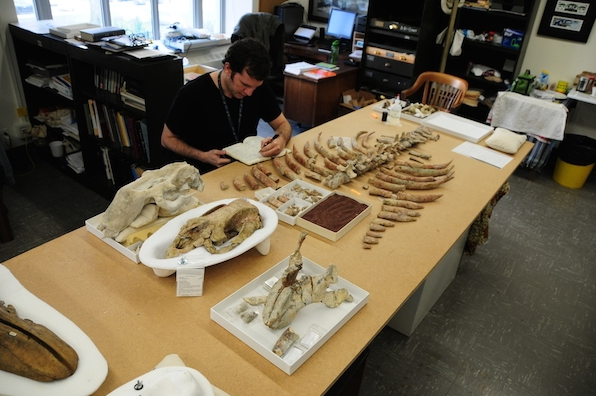
Puerto Rican scientist Jorge Vélez Juarbe, curator of marine mammals at the Natural History Museum of Los Angeles County in California, published a study in the professional journal Journal of Vertebrate Paleontology announcing the discovery of a new genus of fossil sirenian. Together with his colleague Daryl Domning of Howard University in Washington, D.C., the researchers describe the physical characteristics of the bones and argue why they correspond to an extinct dugong.
The fossil was given the scientific name Priscosiren atlantica, which in Latin means “ancestral sirenian of the Atlantic.” It was discovered in San Sebastián, Puerto Rico, and another specimen comes from South Carolina. Although today San Sebastián sits more than 250 feet above sea level, 30 million years ago the landscape of that area was completely different.
Today only four species of sirenians remain. Three of them are manatees: the Amazonian, the West Indian and the African manatee. The fourth sirenian species is called the dugong and lives in the Indian Ocean and the western Pacific. All sirenians are herbivores. Adults measure about 10 feet long and weigh over 1,000 pounds. However, over the past 50 million years other species of sirenians have existed, but they have gone extinct. We know of these prehistoric species because their fossilized bones have been preserved. Radioisotope dating techniques using the chemical elements strontium, potassium and argon—which have excellent precision—are used to measure the age of the rocks where these fossils are found.
Detective scientists make an ancient discovery
“The island of Puerto Rico has changed a great deal over the millennia, whether through global or local processes. During the Oligocene (33.9–23.0 million years ago), parts of what today are Moca, San Sebastián, Lares and Utuado, among other municipalities, were part of the coast facing the Atlantic Ocean. In San Sebastián there were mangroves, beaches and marine lagoons near the mouth of a river,” said Dr. Vélez Juarbe.
Of course, it is very rare for all the bones of an organism to turn up, which makes the work of these researchers extremely complicated. “It is practically detective work,” says the Puerto Rican scientist. “We had to compare practically bone by bone with already known species and, on top of that, make sure there is no variation within the same species, or at least have an idea of what kind of variations can be expected,” explained Dr. Vélez Juarbe.
Drs. Vélez Juarbe and Domning compared the newly discovered bones, especially the skull and vertebrae, with other bones held at the natural history museums of Washington, D.C., Florida and Los Angeles, California. This comparison included both fossil bones and bones of present-day manatees and dugongs. They also consulted articles published over the past 200 years.
The study reported two important findings. First, that the bones of Priscosiren atlantica belonged to a dugong and not a manatee. Among many other differences, dugongs have longer snout bones with a unique curvature that manatee snouts lack. In addition, the teeth and vertebrae of dugongs are quite different from those of the manatee.
A second finding was that Priscosiren atlantica did not share the same physical and feeding characteristics as today’s dugong. Among other things, the researchers noted that the frontal bone of the skull was longer in the fossil, and that its teeth and facial bones were much smaller. It was thus concluded that both skeletons are dugongs, but not of the same genus.
Based on the analysis of Priscosiren atlantica, Drs. Vélez Juarbe and Domning speculate that this prehistoric sirenian could not adapt to the climate changes that began 28 million years ago and culminated 15 million years ago. “The change was relatively rapid during the first 2 million years, which probably caused extinctions and changes in flora and fauna, both locally and worldwide,” Vélez Juarbe maintained.
Unfortunately, history repeats itself in the present. The consensus among scientists is that we are currently living through a process of climate change caused by the burning of fossil fuels that release carbon dioxide into the air. Combined with humans destroying their habitat and killing them (whether on purpose or by accident), it is not surprising that all four remaining sirenian species are at risk of extinction. It would be a shame if the manatees and the dugong met the same fate as the San Sebastián dugong.